Open your server right now. Look at how many members you have, then look at how many are online.
The gap is depressing the first time you notice it. It is also completely universal, and the exact number is more useful than almost anything else on your dashboard.
We studied 211,039 Discord communities to measure it properly. Here is the headline: once a server passes about a thousand members, roughly 8.5% are online at any moment - and that number barely moves no matter how big it gets. A 5,000-member server and a half-million-member server look nearly identical by this measure.
Which means the thing you have been quietly worried about is the thing every large server on Discord also has. But the number is not useless - read against your own size, it is the fastest health check available, and it points at fixes.
The number by size, and why it collapses
Servers under 100 members run at a median of 38.9% online. Between 100 and 999, that falls to 17.2%. Above a thousand it drops to about 8.5%, and then it essentially stops falling - 10k-99k servers sit at 8.8%, and servers over 100,000 sit at 8.7%. The collapse happens almost entirely in the first thousand members, and the reason is not that big servers are worse. It is that member count is cumulative and online count is current. Discord never removes anyone for inactivity, so a five-year-old server's member number includes everybody who joined once in 2021 and never came back, while its online number counts only the people who are actually here today. Small servers have not had time to accumulate those ghosts. This pattern holds across every community we measured, which makes it a reliable benchmark for your own server relative to its size.
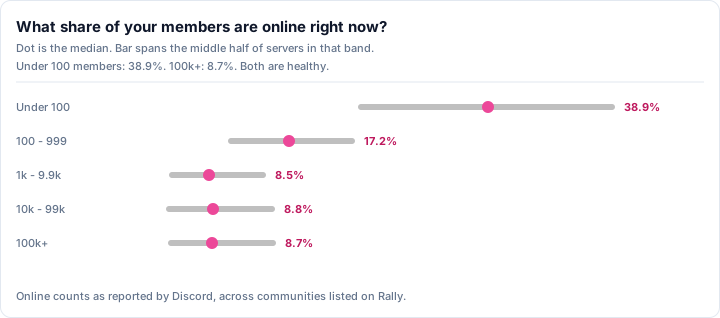
Worth noting immediately: if your server is under 100 members and showing around 39% online, you have the best engagement ratio on this chart. That is not a consolation prize - see below.
Where you actually stand
| Your size | Struggling | Normal | Top quarter |
|---|---|---|---|
| Under 100 | below 25% | 38.9% | above 52% |
| 100 - 999 | below 11% | 17.2% | above 24% |
| 1k - 9.9k | below 4% | 8.5% | above 14% |
| 10k - 99k | below 4% | 8.8% | above 15% |
| 100k+ | below 4% | 8.7% | above 15% |
Find your row. If you are anywhere near the middle column, stop worrying about this metric - it is doing what it does for everyone.
If you are in the left column, that is the one signal here worth acting on, and there are three things that move it.
Small servers are winning a game nobody told them about
Here is the finding that gets buried: a 60-member server at 39% online has 23 people present. A 10,000-member server at 8.8% has 880. The big server wins on raw bodies, obviously.
But engagement rate runs four times higher in the small server, and rate is what a person walking in actually experiences. Twenty-four people in a two-channel server is a conversation. A thousand people spread across forty channels in a server that size is usually four conversations and thirty-six empty rooms.
This is why small communities routinely feel better to be in than large ones, and why "grow the member count" is often the wrong goal. You can trade rate for size, and most servers do it without meaning to.
Three things that actually move the number
Give people a time, not just a place. The most reliable pattern across servers with high online ratios is something recurring that members can plan around - a Thursday voice night, a scheduled game, a standing weekly thread. A server people visit is subject to whether they remember. A server people attend is on their calendar.
Post when your members are awake, not when you are. Most owners post on their own schedule and conclude the server is dead when nobody answers. If your members skew toward one region, the same message posted six hours later can land in a room with ten people in it instead of none. Check where your members are before you conclude they are not there.
Concentrate the activity you already have. Ten active people spread across eight channels look like nobody. The same ten in two channels look like a community, which is what the next visitor sees and decides on. This is the cheapest fix on the list and it takes about ninety seconds.
None of these adds members. All of them raise the number of people who are present at the same time, which is the thing that actually makes a server feel alive - and it is what a visitor is judging when they decide whether to stay.
The number worth remembering
Roughly 8.5% for anything over a thousand members. Around 39% if you are under a hundred.
If you are near your row's median, this metric is telling you nothing is wrong. If you are well below it, the three fixes above are where to start - and none of them require recruiting a single new person.
For the other two halves of this picture: what the average Discord server size actually is - the average is 883, the typical is 30 - and how long growth actually takes, which shows the median ten-year-old server has 873 members.
About the numbers
The Rally Community Study, September 2026: 211,039 Discord communities listed on Rally, using Discord's own reported member and online counts. Point-in-time, so a single server's ratio moves through the day - the medians across thousands of servers are the stable part.
Curious how other communities compare? Browse active gaming servers, anime communities and social servers on Rally.