Every server you admire was once a channel with four people in it and nobody talking.
We can show you that, precisely, because we know when all 211,039 Discord communities in our index were founded - to the day, not self-reported, not estimated. So we sorted every one of them by the year it was born and asked a simple question: how big is each cohort now?
The answer is the most encouraging thing in the whole study. The fastest growth a Discord server will ever see is the growth it is doing right now, in year one - and the bar for a genuinely successful server is far lower than anyone has told you.
The curve
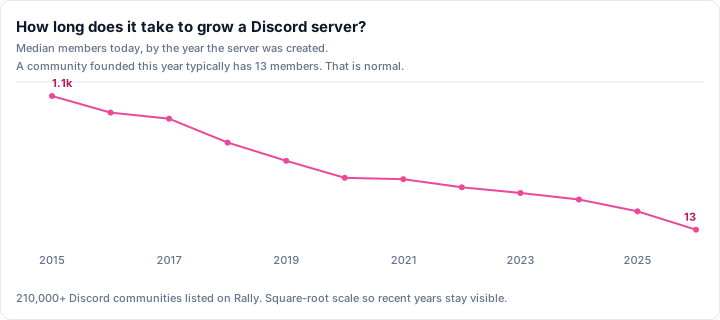
A server founded this year has a median of 13 members. Last year, 59. Two years ago, 106. Three years ago, 138. The shape of that is the encouraging part: year one roughly quadruples you, which is the steepest growth a Discord server ever sees, and it is the part most owners are standing in without realizing it. After that the climb is gentler, adding thirty to fifty members a year. What the curve does not show is the hockey stick everyone waits for, where a community suddenly takes off on its own. That happens to a rare few, and those are the only servers anyone ever talks about, which is exactly why the expectation exists at all. The real pattern is simpler and far more reachable than the myth: grow fastest at the very start, then keep showing up.
| Founded | Age | Median members |
|---|---|---|
| 2026 | this year | 13 |
| 2025 | 1 year | 59 |
| 2024 | 2 years | 106 |
| 2023 | 3 years | 138 |
| 2022 | 4 years | 169 |
| 2020 | 6 years | 228 |
| 2018 | 8 years | 525 |
| 2016 | 10 years | 873 |
The oldest servers we track, founded in 2015, sit at a median of 1,104 - though only twenty-five of them are still listed, so that particular figure is the one to hold loosely. Everything from 2018 onward rests on hundreds or thousands of servers.
Worth acting on right now: if you have been checking your member count weekly, stop. The median server adds roughly three members a month after its first year, so a weekly check measures noise and nothing else. There is a far better number to watch, and it is further down.
Good news: your first year is the fast one
Year one takes you from 13 members to 59 - it roughly quadruples you. Year two nearly doubles that again to 106. That is the steepest part of the whole curve, and it is the part you are standing in right now.
Most advice gets this backwards. It tells you to grind through a long dead phase waiting for some later takeoff. The data says the opposite: the easy growth is at the start, when you are small enough that every single person you bring changes how the room feels.
And the target is far closer than anyone assumes. From the size data:
| Members | Where that puts you |
|---|---|
| 30 | The exact middle of Discord |
| 100 | Top 25% of every server on the platform |
| 369 | Top 10% |
One hundred members puts you ahead of three quarters of Discord. Not ten thousand. A hundred. The median server reaches roughly that in its second year just by existing and being a decent place to be.
That is the whole game, and it is a much shorter game than people think.
Five things that work in year one
These are ordered by how much they move the number, and the first one costs nothing.
Start with ten people you already know. An empty room converts nobody. Ten friends who will actually post give the eleventh person a reason to stay, and the eleventh is the first one you did not have to recruit. Almost every server that grows fast in year one did this on day one.
Pick something narrower than feels comfortable. "Gaming" competes with tens of thousands of servers. "Speedrunning this one game" competes with a handful, and the people who find it stay because there is nowhere else like it. Narrow feels like a smaller ceiling; in practice it is the fastest route to a room that feels alive. You can always widen later, from a position of having regulars.
Two channels, not twelve. Ten active people spread across eight channels look like nobody. The same ten in two channels look like a community, and that is what the next visitor sees before deciding to stay. Split a channel only when it is genuinely too busy - a good problem, and not one you will have for a while.
Give people one reason to show up on a specific day. A Thursday game night, a Friday thread, a weekly prompt. It converts a server I joined once into a thing I do, which is the whole mechanism behind regulars. One repeating thing beats ten great one-offs.
Hand out ten small jobs. Not moderation - a reason to be needed. Someone who runs the movie night, someone who posts the art prompt, someone who welcomes new joins. Ten people with a role is a community that runs itself. A hundred passive members is an audience that does not.
Two habits that make year one feel easier
Measure conversations, not members. This is the better number promised earlier, and it is embarrassingly simple: how many different people posted yesterday? Member count moves too slowly to tell you anything in year one and it counts people who will never speak. Unique posters moves daily, responds to things you actually control, and is the only number that separates a small community from a quiet one. Five posters in a forty-member server is genuinely thriving.
Check monthly, not weekly. At the median rate you are gaining a few members a week, so a weekly check measures noise. Monthly, the growth is obvious and encouraging - the same progress, just read at the right resolution.
The one number worth remembering
One hundred members puts you in the top 25% of every Discord server there is.
That is the number worth aiming at, and the median server gets there in its second year. Not ten thousand, not a hockey stick - a hundred people who like the place, reached during the fastest part of the curve, which is the part you are in right now.
If you are at 13 in your first year you are exactly on pace. If you are at 60 you are ahead of half the servers founded when yours was.
For where you land against every server rather than your own cohort, see the average Discord server size - short version, the average is 883 and the typical is 30.
About the numbers
The Rally Community Study, September 2026: 211,039 Discord communities listed on Rally, grouped by founding year. Founding dates are exact rather than estimated or self-reported. Two caveats worth stating plainly. We can only measure servers that still exist, so the older cohorts are the ones that made it - this is the survivors' curve, which is the one worth having, because it maps what lasting actually looks like. And the 2015 cohort is only twenty-five servers, so the far left of the chart is the one point to read loosely; every year from 2018 on rests on hundreds or thousands.
Want to see communities at every stage? Browse gaming, art and social servers on Rally, from forty-member rooms to the ones with millions.