There is something that happens in a fitness accountability community that does not happen anywhere else: someone posts their workout at 5:47am before work, and six other people have already posted theirs. You are not alone in your training anymore. The gym is isolating by design - headphones in, focus on the work, minimal acknowledgment of the other people doing the same thing. Discord fitness communities invert this. The training itself stays private, but the commitment becomes public, and that small difference changes everything about follow-through.
Fitness communities have built some of the most practically effective accountability structures on Discord. What looks from the outside like people posting gym selfies and meal pictures is, in its best form, a genuine mutual accountability system that produces measurable behavior change in its members. The people who stay in these communities for months and years are, as a group, training more consistently than they would be alone.
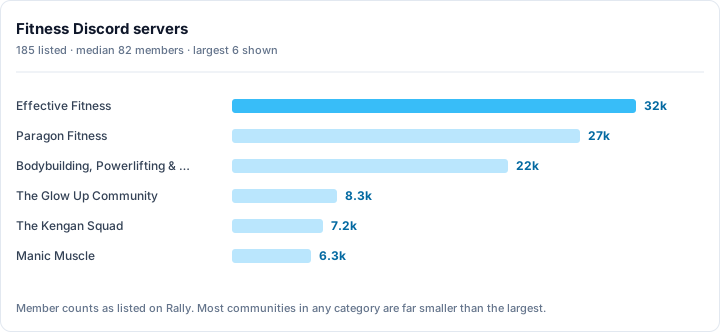
What the Activity Patterns Reveal
Fitness communities on Discord show a distinctive daily rhythm that mirrors the training schedules of their members. Early morning activity - 5am to 8am - is disproportionately high compared to most other community categories, driven by before-work trainers posting their completed sessions. There is another peak in the early evening as after-work lifters and runners check in. Weekends show a different pattern: weekend long runs, open gym sessions, and meal prep content drive activity at different hours. These patterns reveal how accountability structures shape member behavior. Members who engage with others' posts retain at significantly higher rates than those who post without interacting, because the accountability works bidirectionally: you feel obligated to post when you know people are looking, and you stay because the people whose posts you follow become part of your routine. The communities with the strongest sustained activity run programming beyond passive channels: weekly challenges, form check threads with real feedback, nutrition Q&A, and monthly goal-setting that creates checkpoints members feel accountable to.
The communities with the strongest sustained activity share a structural investment: they run programming beyond passive channels. Weekly challenges, form check threads with real feedback, nutrition Q&A sessions, and monthly goal-setting rituals that create checkpoints members feel accountable to. The servers that only have a check-in channel and a general discussion room plateau quickly. The ones that build recurring events and community projects sustain momentum for years.
Rally's data also shows that fitness communities have unusually strong mutual accountability dynamics - members who engage with others' posts retain at significantly higher rates than those who post without interacting. The accountability is bidirectional: you feel more obligated to post when you know people are looking, and you stay because the people whose posts you follow have become part of your routine.
The Ecosystem: Types of Fitness Communities
Strength and Powerlifting Communities
These communities are organized around one question: are you getting stronger? Powerlifting and strength training servers track numbers - one-rep maxes, training percentages, progressive overload week over week. The culture is technical and methodical, with detailed discussion of programming philosophy, periodization, and peaking protocols.
Form check culture is a defining feature of the best strength communities. Members post video of their lifts and receive structured feedback on technique - bar path, bracing, stance, depth. The quality of form check feedback varies enormously between servers, and it is the most reliable indicator of community expertise. A form check channel where experienced lifters provide detailed, actionable notes is a community asset worth more than any pinned resource doc.
The strength community also has strong programming culture: discussions of Wendler 5/3/1, GZCLP, Texas Method, RTS, and dozens of other frameworks happen in parallel. Members share their training logs, compare progress across different approaches, and develop individualized programs through iterative discussion with more experienced members.
Running and Endurance Communities
A completely different energy. Running communities are organized around distance, pace, and the peculiar form of suffering that endurance training requires. There are beginner communities built around programs like Couch to 5K, competitive communities focused on marathon PR chasing, trail running communities, and ultramarathon servers where 100-mile events are considered a reasonable weekend.
The culture in running communities is notably collaborative compared to strength training spaces. Partly this reflects the nature of the sport - runners are rarely in direct competition with each other in daily training, so the community ethos is more generative. Strava integration is common in active running servers, where members link their training logs and receive comments on runs. Race day support - members following tracking and posting encouragement in real time - is a recurring community ritual that builds strong bonds.
Bodybuilding and Physique Development
These communities bridge training and nutrition more deeply than almost any other fitness category. Bodybuilding servers discuss progressive muscle development, competition prep, cutting and bulking cycles, and the careful periodization of both training and diet. The culture tends toward patience - physique development is a multi-year project, and the communities that support it well have strong norms around long-term thinking over short-term hacks.
Progress photo culture is central in physique communities and done well, it is genuinely useful - side-by-side comparisons over months or years are the most honest feedback mechanism available. Done badly, it becomes a context for comparison and body image pressure. The best physique communities have explicit norms around supportive feedback and zero tolerance for comments that degrade rather than encourage.
Home Workout and Minimal Equipment Communities
A category that grew substantially and has maintained its membership. Home workout communities serve people who train without gym access - home gym builders, apartment dwellers working with resistance bands and bodyweight, travelers maintaining fitness on the road. The creative constraint is the community bond: swapping programming ideas for limited equipment, reviewing home gym setups, and adapting gym-based programs for living room use.
These communities tend toward inclusiveness by nature. The barrier to entry is lower, the judgment about equipment quality is largely absent, and the shared understanding that members are making the most of their constraints creates solidarity that some larger gym-focused communities lack.
Nutrition-Focused Communities
Dedicated to the dietary side of fitness. These range from general nutrition discussion servers covering macros, meal planning, and food quality to specific communities built around dietary approaches (whole food plant-based, carnivore, ketogenic, Mediterranean) to calorie-counting and flexible dieting communities. Recipe sharing, meal prep logistics, and grocery optimization are common activities.
The quality signal in nutrition communities is the relationship with evidence. Strong communities distinguish between well-established nutritional science and emerging research, acknowledge uncertainty where it exists, and are skeptical of extreme claims. Servers dominated by single-approach dogma - where one eating style is presented as universally optimal and alternatives are dismissed - tend to have lower quality discussion and more conflict.
What Makes the Best Fitness Communities Stand Out
Accountability culture that goes beyond posting. The check-in channel is the foundation, but the communities that produce real behavior change have accountability structures that go deeper. Partners matched for similar schedules and goals. Weekly calls where members share their plans and actual results. Streak acknowledgments that make consistency visible. The act of making your commitment visible to people you actually know in the community, not just a server of strangers, is what drives follow-through.
Evidence-based advice culture. Fitness is one of the most myth-dense topics on the internet. The communities worth spending time in are the ones where members cite sources, distinguish between individual experience and general principles, and push back on broscience with specific counterevidence. Look for servers that actively debunk common misconceptions rather than just tolerating them.
The Form Check Test
The quality of a fitness server's form check culture tells you everything about the community's expertise level. Find a recent form check thread and read the feedback. Is it specific and actionable, or generic? Do experienced members provide cues that would actually improve technique? This single channel reveals more about community quality than any server description.
Rest and recovery as a genuine community value. The best fitness communities normalize rest days, injury prevention, and long-term sustainability. Communities where members brag about training through pain, where deload weeks are treated as weakness, and where training volume is always framed as "more is better" are communities pushing members toward burnout and injury. The culture around rest is a direct indicator of overall community health.
Programming diversity and individualization. No single program works for everyone, and the communities that acknowledge this produce better outcomes than the ones built around a single method. Servers where members run different programs, compare results honestly, and adapt recommendations to individual circumstances are more useful than monolithic "our method" communities.
For Fitness Community Builders
The most valuable investment is in your accountability infrastructure. Design check-in channels with clear norms about what to post and how to respond. Create streak recognition that makes consistency visible and celebrated. Match members with accountability partners who share similar schedules. These structural choices determine whether your community produces behavior change or just hosts discussion.
Build programming resources as community projects. The best fitness servers have resource libraries that members actively maintain - pinned guides regularly reviewed for accuracy, FAQ channels updated as common questions evolve. This investment serves new members immediately and gives experienced members a contribution path that keeps them engaged.
Manage the evidence quality of your community. Appoint moderators with training knowledge who can gently correct misinformation, provide better answers alongside corrections rather than just flagging problems, and model the culture of evidence-based discussion that you want members to adopt.
Explore Fitness Communities on Rally
Rally surfaces fitness communities ranked by genuine activity - real members checking in, posting workouts, and supporting each other, not inflated counts or inactive servers. Browse active fitness servers to find communities where people are actually training together and where accountability is more than a channel name.