


Fitness and Discord were made for each other. The platform launched when your only option for accountability was hiring a trainer or dragging a friend to the gym at 5 AM. Now, over 3 million people use Discord for fitness community-from casual joggers sharing morning runs to competitive bodybuilders analyzing peak week protocols. The fitness Discord ecosystem is massive, specialized, and increasingly professional.
But not all fitness servers are built equally. A server with 50 active members who check in daily and push each other toward PRs is infinitely more useful than one with 50,000 inactive profiles and a welcome message from 2022. The servers ranked above are the ones where people are actually training, where accountability is real, and where you can find training partners, form critique, and genuine motivation.
How We Ranked These Fitness Servers
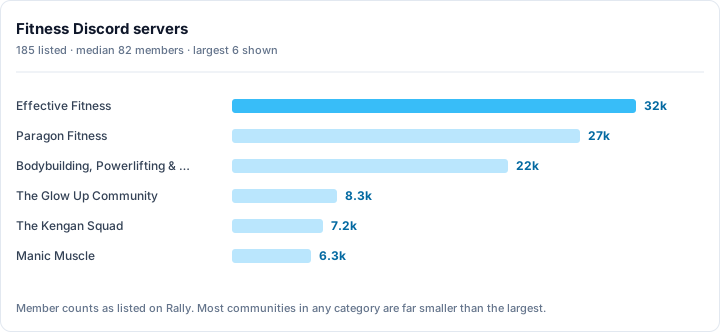
Rally's ranking methodology cuts through the noise by prioritizing what actually matters: active member engagement where people consistently post check-ins, PRs, and form questions; real-time accountability through daily or weekly check-in culture with genuine participation; expertise visibility from coaches and experienced lifters who answer questions; and consistency across time zones and seasons. The methodology deliberately ignores total member count because a server with 500 active lifters outperforms one with 100,000 inactive accounts. Over 3 million people now use Discord for fitness community, but not all servers are built equally - a server with 50 active members who push each other toward PRs is infinitely more useful than one with thousands of inactive profiles and outdated welcome messages. Rally's approach recognizes that the servers where people are actually training, where accountability is real, and where you can find training partners and genuine motivation are the ones that deserve recognition.
- Active member engagement - Members posting check-ins, PRs, and form questions consistently
- Real-time accountability - Daily or weekly check-in culture with genuine participation
- Expertise visibility - Coaches, experienced lifters, and knowledgeable members answering questions
- Consistency - Communities that stay active across all time zones and seasons, not just during New Year's resolution season
We do not rank by total member count. A server with 500 active lifters beats one with 100,000 inactive accounts every single time.
The Major Fitness Discord Categories
Strength Training and Lifting
Powerlifting, bodybuilding, strongman, and general strength communities. These servers dive deep into programming, periodization, exercise selection, and technique breakdown. Expect detailed discussion of programming methodology (5/3/1, linear progression, conjugate, undulating periodization), form critique in dedicated channels with video submissions, and PR celebrations that actually matter because the community knows what a legitimate lift looks like. The best strength servers have tiered roles based on total or experience level - not for gatekeeping, but for filtering conversations to appropriate depth.
Running and Endurance
Communities for runners of all distances and paces. From casual 5K joggers to ultramarathon runners, these servers share training plans, race recaps, route recommendations, and injury recovery strategies. Many have regional channels for organizing local group runs, and the best maintain pace-progression data so you can track improvement across a season. Trail running, road running, and track communities often have distinct channels within larger servers, and many runners participate in all three.
Nutrition and Diet Communities
Distinct from general fitness, these servers focus on macros, meal prep, specific dietary approaches (keto, vegan, carnivore, paleo), and supplement discussion. The quality of nutritional advice varies wildly - the best communities have registered dietitians or certified sports nutritionists actively participating. Many embed macro calculators and meal planning tools. Some communities organize group meal prep or grocery shopping challenges to reinforce consistency.
Yoga and Mobility
Lower-energy but equally committed communities focused on flexibility, injury prevention, and mind-body practice. These servers share routines, pose modifications, and breathing techniques. They are often less text-heavy than strength communities and more visual - pose photos, form checks, and routine breakdowns. These communities tend to be more welcoming to beginners than strength communities, which is a conscious choice about inclusive culture.
Fitness Accountability and General Wellness
Broad-based servers focused on showing up and making progress, regardless of specific discipline. These often attract people in fitness journeys who are not yet sure of their niche - they might strength train 3 days a week, run on off-days, and do yoga for mobility. The best general fitness servers have good channel organization so conversations do not bleed together, and they explicitly welcome different fitness paths.
Sport-Specific Training
Communities built around training for specific sports - basketball, soccer, climbing, martial arts. These blend strength, conditioning, skill work, and sport-specific technique. Many are organized around high-level competition but welcome recreational players. The best sport-specific servers have guest appearances from coaches or athletes, creating a connection to professional-level training.
What Makes a Great Fitness Discord Server?
Genuine Accountability, Not Judgment
The core difference between a good fitness server and a toxic one is simple: do people genuinely care about your progress, or are they evaluating whether you deserve to be there? In a great fitness server, a beginner asking about form on a barbell squat gets patient corrections from experienced lifters. In a toxic one, they get gatekeeping. The best communities celebrate progress at all levels - a 135-pound deadlift is a massive milestone for someone who has never lifted, and communities that recognize this retain members far longer.
Active Moderation With Clear Values
Fitness communities can get heated. Steroid discussion, diet debates, exercise science disagreements - these are inherent to the space. The best communities have moderators who enforce a baseline of respect without policing legitimate debate. Check the rules channel and look for recent mod activity. A fitness server with weeks of spam and no moderator response is one where moderation has failed.
Real Check-In Culture
The single strongest predictor of a valuable fitness community is regular, visible check-in activity. Members posting progress photos, PRs, training logs, or simple "did my workout today" messages. Telling other people what you intend to do makes you far likelier to do it, which is most of why check-in channels work at all. The best fitness servers have dedicated check-in channels, and members actually use them. If no one has posted in the main check-in channel in three days, that community is coasting.
Expertise Visibly Present
You do not need every member to be a certified coach. But the best fitness servers have at least a few genuinely knowledgeable people actively answering questions - coaches, experienced lifters, sports nutritionists, physical therapists. Look for evidence of real expertise in pinned messages, FAQ channels, or a visible role system that identifies experienced members. Avoid servers where anyone with 6 months of training feels confident giving advice to beginners.
Organized By Actual Categories
A great fitness server has structure. Separate channels for strength training, cardio, nutrition, mobility, form checks, progress photos, off-topic. A poor one has everything in general chat. Look for whether channels are actually being used for their intended purpose, or whether the server has channel bloat with dead spaces.
Finding Your Fitness Discord Niche
Start with your current focus. If you are primarily a lifter, find a lifting community first. If you run, find runners. This is the clearest path to a server where conversations actually serve you. Rally lets you browse by tag - start at fitness servers on Rally and search by your discipline.
Match your experience level carefully. A beginner joining a highly competitive powerlifting server optimized for 1,200+ pound totals will feel lost. Similarly, an experienced lifter in an all-beginner server will get bored. Look for servers that explicitly welcome your experience level and have channels organized by progression.
Check check-in participation first. Before reading the description or joining, scroll through the check-in channels. Are people actually posting? How recent are updates? A server with enthusiastic daily check-ins is likely to be motivating. One with months of silence between posts is a ghost town wearing fitness clothes.
Lurk for a day before committing. Join, sit in voice or general chat, and see if the vibe matches. Are conversations about fitness philosophy or just memes about leg day? Both have value, but the ratio matters. There is no reason to stay somewhere that does not feel right.
Building a fitness community? If you run an active fitness server, list it on Rally to reach people looking for accountability and progression, not inflated member counts.
Red Flags in Fitness Discord Servers
Constant steroid talk with zero natural-focused spaces. Some fitness communities are heavily oriented toward enhanced athletes. This is fine if that matches your path - but if you are training naturally, make sure the server has realistic natty role models and programming designed for natural lifters.
No moderation of misinformation. Someone confidently sharing terrible nutrition or training advice, with no correction from knowledgeable members. This is especially dangerous in fitness communities because bad information can lead to injury or ineffective training.
Gatekeeping beginner questions. "Go read a wiki" or "that is such a dumb question" in response to someone genuinely asking. A great community answers beginner questions patiently because every expert was once a beginner. If the default response to "how do I start strength training" is mockery, leave.
Months of inactivity on check-in channels. A fitness server where no one is posting progress photos or check-ins is one where accountability has collapsed. The server may look nice, but no one is actually using it to train.
Unrealistic standards or appearance focus. Some fitness communities are fundamentally about aesthetics and comparison. If the culture is "your body does not look elite enough," that is a specific vibe - it is just not one that retains people long-term. The best communities focus on progress, strength, and consistency.
The Bottom Line
A great fitness Discord server is not about how many bots it has or how aesthetically designed it is. It is about people - real ones, checking in daily, sharing progress, giving form critique, and pushing each other to be stronger today than yesterday. The servers ranked above are the ones where that is actually happening.
Browse active fitness communities on Rally, find one where people are genuinely training together, and join. If you run a fitness community with real engagement, add it to Rally and connect with people looking for accountability, not inflated member lists.