Collaborative fiction is one of the oldest forms of human play. Before anyone had written down a story, people were telling stories together - taking turns, building on each other's contributions, inhabiting characters and seeing where the story went. Discord roleplay communities are the most sophisticated version of this that has ever existed at scale: persistent fictional worlds, complex character histories, multi-year story arcs, and tens of thousands of simultaneous participants, all coordinating in real time through written prose.
The form is genuinely its own medium. It is not like reading a novel - you are not a passive audience, you are a writer and an actor simultaneously. It is not like tabletop RPG, where sessions are scheduled and the world pauses between meetings - a Discord RP world runs continuously, with events happening while you are offline that you read about when you return. It is not like collaborative writing, where you draft together toward a finished product - the point is the process, the accumulation of story, the relationships between characters that develop over months and years of interaction.
What the Activity Patterns Reveal
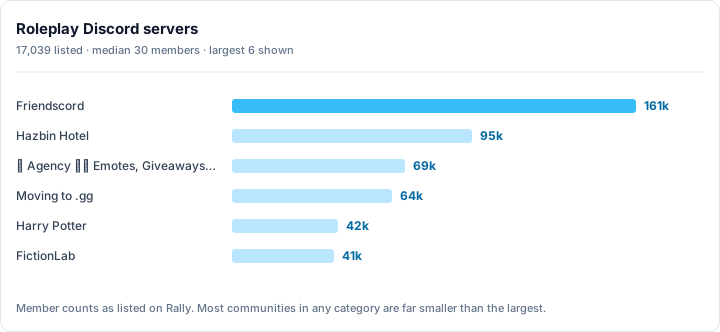
Roleplay communities show one of the most persistent activity profiles of any category on Discord. Unlike gaming servers that spike around launches and go quiet between them, or entertainment communities that respond to external content calendars, RP servers generate their own momentum through ongoing stories that do not have natural endpoints. The most active roleplay communities maintain engagement through active plot infrastructure - staff-driven story events where something significant happens in the world that all characters must respond to, creating reasons to log on even for members whose engagement had been fading. Long-running RP servers develop genuine character histories that cannot be replicated elsewhere: a character played for two years accumulates relationships, reputation, and history with other characters that becomes the strongest retention mechanism these communities possess. This accumulated investment, combined with the continuous nature of the world - events happening while you are offline that you read about when you return - creates a fundamentally different engagement pattern than gaming or entertainment communities experience.
The most active roleplay communities have something specific: active plot infrastructure. Staff-driven story events - something significant happening in the world that all characters must respond to - create engagement spikes that bring even intermittently active members back into the story. A political crisis in the capital city, a monster attack on a border town, the arrival of a mysterious stranger - these events function like episode releases in a serial narrative, creating reasons to log on and participate even for members whose engagement had been fading.
Long-running RP servers also develop something rare in online communities: genuine character histories. A character that has been played for two years in a persistent world has relationships, reputation, scars, achievements, and history with other characters that cannot be replicated by a new server or a new character. This accumulated investment is the strongest retention mechanism roleplay communities possess.
The Ecosystem: Types of Roleplay Communities
High Fantasy Worlds
The dominant category and the broadest in execution. High fantasy RP servers range from Tolkien-adjacent traditional settings (elves, dwarves, dark lords, magical academies) to fully original worlds with proprietary lore, unique magic systems, custom races, and geopolitical complexity that rivals published secondary world fiction. The investment in world-building in the best high fantasy servers is extraordinary - thousands of words of lore documents, commissioned maps, character guides, and the accumulated history of years of collaborative story.
The culture in established fantasy servers tends toward deep investment. Members who have played in a world for more than a year have characters with genuine history, relationships, and development arcs. The community around these characters - the out-of-character relationships between players who have written together for years - often becomes as meaningful as the in-character story itself.
Character application culture is most fully developed in high fantasy communities. The application process in serious fantasy servers can be extensive: character backstory, personality, relationship to the world's lore, power level calibration, and sometimes a writing sample demonstrating the player's prose style. The investment required is also the signal: servers that require substantial applications attract members who will invest substantially in the story.
Science Fiction Communities
A distinct culture with its own preoccupations. Space opera servers set aboard starships or across planetary systems, hard science fiction communities that take worldbuilding constraints seriously, cyberpunk settings in near-future megacities, post-apocalyptic survival narratives, and time travel settings each have their own sub-culture and expectations.
Science fiction RP communities tend to have stronger system integration - technology, faction hierarchies, and rule sets that govern how the world functions. The best sci-fi servers have invested in the operational logic of their worlds in a way that gives player choices meaningful consequences: which faction you ally with affects your access to resources and storylines, which planet you are based on affects your character's practical options, which technology you have access to shapes what is possible for your character to do.
Fandom and Canon Universe Communities
Built around established fictional universes rather than original worlds. Every major franchise with a passionate following has RP communities: specific book series, anime, games, films, and television universes are all represented. Members play either original characters within the established world or canonical characters from the source material (with norms varying widely on whether canon character play is welcomed or restricted).
Fandom RP communities have a specific advantage: the world-building is done. Members arrive with shared context that does not require extensive onboarding, because they already know the setting, the tone, and the rules. The challenge is the reverse: maintaining a consistent feel with established source material that continues to evolve, managing disagreements about canonical events, and finding story space in universes where canon characters dominate the narrative.
Slice-of-Life and Social RP
The most character-driven, lowest-stakes category. Slice-of-life servers are not built around conflict or adventure - they are built around character interaction, relationship development, and the small moments of daily life in a fictional setting. High school settings, small town community spaces, coffee shops and apartment buildings, university campuses - the world is contemporary or near-contemporary, the drama is human rather than epic, and the point is character.
These communities attract writers who are more interested in psychology and relationship dynamics than in combat and plot. The writing quality in strong slice-of-life communities is often exceptional precisely because the craft challenge is more demanding: when nothing dramatic is happening, the quality of the prose and the specificity of the character voice is all you have.
Horror and Dark Theme Communities
A specialized category with specific requirements around consent and content management. Horror RP servers generate genuine tension through atmosphere, pacing, and the specific craft of building dread in written prose. Cosmic horror, psychological horror, survival horror, and gothic horror each have their own communities with distinct tonal expectations.
The moderation requirements for horror communities are higher than other categories because the content approaches genuinely distressing material. The best horror RP servers have explicit content warning systems, opt-in structures for the darkest storylines, and moderation that distinguishes between thematic darkness serving the story and content that is gratuitous or harmful. Horror communities that manage this well produce genuinely remarkable collaborative fiction; those that do not protect their members adequately produce the worst experiences in roleplay Discord.
What Makes the Best Roleplay Communities Stand Out
World-building depth that rewards investment. A roleplay world is only as engaging as the fictional context it creates. The communities worth investing time in have built worlds with internal logic, historical depth, and enough detail that player choices have meaningful context. The best servers' lore documents are works of collaborative fiction in themselves - maps, histories, faction guides, bestiary entries - that new players can study before they begin and veteran players continue to discover.
Active storytelling staff. The single most important factor in a RP community's vitality is the quality and activity level of its staff - the admins, game masters, and loremasters who drive plot events, respond to player initiatives, and maintain the integrity of the world. A RP server without active staff is a collection of player characters in a vacuum. Staff who run regular plot events, respond to player-driven storylines, and create a sense that the world has momentum are the engine of the community.
Evaluating Staff Activity
Before joining a roleplay community, check the announcements or plot events channel. How recently was the last staff-driven event? Is there a schedule of upcoming events? Active staff who run regular storylines is the single most reliable predictor of a RP community that will still be thriving in a year.
Character progression that feels meaningful. The best RP communities create systems through which characters grow, change, and develop in response to their experiences. This can be mechanical - experience point systems, skill progression, reputation tracking - or purely narrative, with staff keeping track of significant character events and incorporating them into future storylines. When characters feel static regardless of their experiences, investment fades. When what happens to a character has lasting consequences in how the world treats them, the story feels real.
Consent and content safety systems. Collaborative fiction explores the full range of human experience, including difficult and dark themes. The communities that handle this well have explicit systems: opt-in rather than opt-out for dark content, content warnings at the start of scenes involving violence or other difficult material, clear moderation on the distinction between thematic darkness and harmful content, and a culture where players feel safe using out-of-character communication to stop or redirect a scene that has gone somewhere they are not comfortable with.
For Roleplay Community Builders
World-building is your primary investment before you open your server to members. A RP community launched without sufficient lore infrastructure forces players to make choices without context, which produces inconsistent stories and conflicts about what the world actually is. Build your world first: core history, active factions, major locations, the rules of your magic system or technology, the current political situation. The more context you provide before the first player creates a character, the more coherent the emergent stories will be.
Staff planning is more important than member acquisition. A RP server with ten deeply invested staff members who run regular events will generate more activity than one with a thousand members and no active leadership. Recruit your storytelling team before you recruit your players, and build staff culture deliberately - shared vision about the world, clear responsibilities for who runs what storylines, and communication channels between staff members that keep everyone coordinated.
The application process is your quality filter. The depth and rigor of your character application process signals what kind of community you are building and filters for the members who will match it. A thorough application that requires genuine investment to complete will produce a community of genuinely invested players. An open-access server will have volume but less consistent quality. Decide which trade-off fits your goals before you set your entry requirements.
Explore Roleplay Communities on Rally
Rally surfaces roleplay communities ranked by genuine activity - servers with active players, running stories, and ongoing plot events, not dormant worlds with high member counts from past launches. Browse active roleplay servers to find a community building the kind of collaborative fiction you want to be part of, at the level of investment that matches where you are as a writer and player.