


Making friends as an adult is genuinely hard. The structures that create friendship naturally - school, sports teams, neighborhoods, shared workplaces - either disappear or become less central as people get older. Most adults report that their last significant new friendship formed years ago, often at a life transition moment like moving to a new city or starting a new job.
Discord has quietly become one of the most effective platforms for solving this problem. With 19 million active servers spanning essentially every interest, hobby, and identity, it provides something uniquely powerful for friendship formation: sustained, low-pressure repeated contact with people who share your specific enthusiasms. That is the actual recipe for friendship - not a single great conversation, but dozens of smaller interactions that accumulate into genuine connection.
Why Discord Actually Works for Making Friends
Researchers who study friendship formation consistently identify two factors that matter most: proximity (being in the same environment repeatedly) and unplanned interaction (conversations that happen without explicit social agenda). Discord creates both of these conditions digitally. When you join a community centered on something you genuinely care about and show up consistently, you start recognizing the same people, noticing who makes you laugh, and seeking out the same voices. This passive familiarity - the sense of knowing someone without ever explicitly declaring friendship - is the soil from which real friendship grows. Discord's voice channels add another layer by allowing you to hang out with people talking about nothing in particular, which is the digital equivalent of sitting together in a common room. This casual co-presence is how most real friendships actually develop, built through dozens of smaller interactions that accumulate into genuine connection rather than a single great conversation.
When you join a community centered on something you genuinely care about and show up consistently, you start recognizing the same people. You notice who makes you laugh. You find yourself seeking out the same voices. You develop what social scientists call "passive familiarity" - the sense of knowing someone without ever having explicitly declared the friendship. That passive familiarity is the soil from which real friendship grows.
Discord's voice channels add another layer. Hanging out in a voice channel with a few people, talking about nothing in particular, is the digital equivalent of sitting together in a common room. The content of the conversation matters less than the shared presence. This casual co-presence is how most real friendships actually develop.
Categories of Friendship Discord Servers
Interest-Based Communities (The Most Natural Path)
The most effective route to making friends on Discord is joining communities organized around something you genuinely care about - a game, a creative hobby, a shared identity, an intellectual interest. These communities create friendship as a byproduct of shared engagement rather than as an explicit goal.
When you spend time in a gaming server talking about a game you love, or in a writing community workshopping each other's drafts, or in a music server sharing tracks and asking for recommendations, you are doing what humans have always done to form friendships: spending time together doing things that matter to you. The online context changes the medium, not the mechanism.
The advantage of interest-based communities for friendship is that there is always something to talk about. The shared interest provides a conversation infrastructure that purely social "make friends" servers often lack. You never run out of things to discuss because the interest itself is generative.
Dedicated Social and Friendship Servers
Servers built explicitly around meeting people and socializing, rather than around a specific interest. These vary enormously in quality. The best ones are structured to facilitate genuine connection: they have icebreaker events, regular voice hangouts with games or activities to break awkward silences, matching systems that pair members with compatible people for one-on-one conversation, and community events that give everyone a shared experience to discuss afterward.
The worst friendship servers have no structure - just a large number of people in a general channel with no mechanism for connection. These feel like attending a large party where you know no one and there is no activity to gather around. People mill around, a few existing friend groups dominate conversation, and newcomers leave without having connected with anyone.
When evaluating a dedicated social server, look for structural features: Do they run regular events? Do they have voice channels with consistent activity? Do they have systems for introducing newcomers? These signals indicate a community that has thought seriously about how connection actually happens.
Age and Demographic Communities
Many people find it easier to connect with people who share their life stage. Discord communities organized around age ranges (20s, 30s, college students, adults over 40), parenting status, professional situations, or life transitions provide demographic context that makes initial connection easier.
A server for adults in their 30s will naturally attract people navigating similar life territory: career development, relationship questions, the identity shifts of early adulthood fading into more settled middle adulthood. These shared contexts create conversation material that cross-demographic spaces lack.
Similarly, communities for people in specific life situations - new to a city, going through major life transitions, dealing with specific challenges - create connection through shared circumstance. Moving to a new city Discord servers, for example, serve genuine practical needs while creating community around a specific shared experience.
Gaming and Activity-Based Social Servers
Gaming communities where the explicit purpose is both playing together and socializing represent one of the most effective friendship-formation environments on Discord. The shared activity (gaming) reduces social pressure while creating natural conversation and cooperation. Playing games together activates social dynamics (collaboration, friendly competition, shared humor in response to in-game events) that accelerate connection faster than passive conversation.
Games that require cooperation - squad-based shooters, MMOs, cooperative strategy games - are particularly effective at building bonds because teamwork creates the kind of mutual reliance and shared challenge that bonds people. When you help someone through a difficult game section, or when a team wins a close match together, the positive emotion is immediately shared and reinforcing.
The friendships that form in gaming communities are often among the most durable on Discord precisely because they are built on hundreds of hours of shared experience rather than conversation alone.
Creative and Collaborative Communities
Writing groups, art communities, music collaboration servers, filmmaking servers - communities where people create things together build particularly strong bonds. Creating something with someone creates mutual investment and vulnerability that conversation alone cannot produce.
A writing community where members share drafts and receive feedback develops deep trust. When someone reads your unfinished work and responds thoughtfully, you have shared something genuinely personal. The same happens in art critique communities, music feedback channels, and collaborative project groups. Shared creative vulnerability builds friendship faster than almost any other activity.
These communities also create natural ongoing relationship continuity - members follow each other's creative development over time, celebrate completed projects together, and build shared history around the creative work.
How to Actually Make Friends (Not Just Join Servers)
Show up consistently. Friendship requires repeated interaction. Joining ten servers and lurking in all of them will not produce friends. Finding two or three communities and showing up regularly will. Members who are present consistently become recognizable. People seek out familiar voices.
Use voice channels. Text conversation creates connection, but voice conversation deepens it dramatically. The cadence, humor, and personality that emerge in voice are different from text. If a community you are in has active voice channels, use them. The initial awkwardness of jumping into voice dissolves quickly.
Engage with what others share. Friendship is built through reciprocal attention. When someone shares something - a creative work, a personal update, a question - responding thoughtfully signals genuine interest. People remember who engaged with their contributions.
Be specific in your own sharing. Vague, generic conversation does not build connection. Specific details - your particular excitement about something, a specific thing that happened, a genuine opinion about a specific topic - create the distinctiveness that makes you memorable and interesting.
Move conversations forward. After a good exchange with someone in a server, follow up. Reference something they mentioned previously. Ask about a project they were working on. These callbacks signal that you were genuinely paying attention, which is one of the most powerful connection signals available.
Participate in community events. Most active friendship servers run events - game nights, movie watches, creative challenges, voice hangout events. These create shared experiences and natural conversation material. Attending events is the fastest way to become integrated into a community.
Red Flags in Friendship Discord Servers
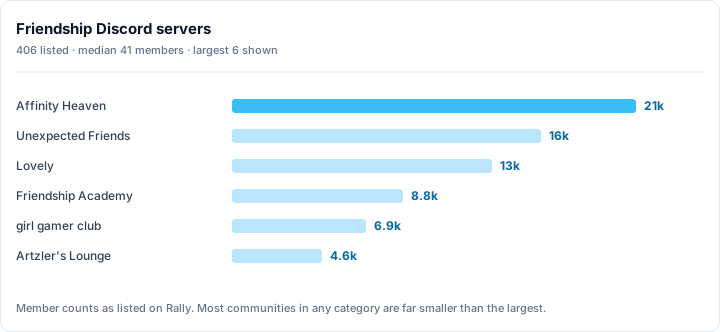
Low activity with high member counts. A 20,000-member friendship server with 30 people online is not a vibrant social community - it is a server that recruited aggressively and retained nobody. Check online counts and voice channel activity before investing time.
No structure for meeting people. Servers that provide no mechanism for connection - no introductions channel, no events, no icebreaker systems - will not produce friendships for most members. Some people are extroverted enough to create connection in structureless environments; most are not.
Cliquish existing groups. Some friendship servers have calcified social hierarchies where existing groups dominate and newcomers cannot break in. Look for community cultures where newcomers are actively welcomed and integrated, not ignored.
Pressure or desperation. Healthy social servers feel relaxed. If a community feels desperate - if people are aggressively trying to form connections or there is social pressure to perform friendship - it will not produce genuine connection. Real friendship cannot be forced.
Harassment or inappropriate behavior. Friendship Discord should be safe. Servers that do not moderate harassment, unwanted DMs, or inappropriate advances create environments where people (especially women and members of marginalized groups) cannot comfortably engage.
The Consistency Rule
The single most reliable predictor of making friends in a Discord community is showing up consistently over weeks or months, not the quality of your opening conversation. Most people who feel like they "cannot make friends on Discord" joined servers once, had a few conversations, and left when friendship did not materialize immediately. Friendship takes time everywhere - Discord is no different.
Find Social Communities on Rally
Rally tracks activity across thousands of Discord communities in real time. Browse social servers to find communities ranked by genuine engagement - active voice channels, regular community events, and consistent member participation. The activity rankings surface communities where people are actually showing up and connecting, not just servers that accumulated members during a promotional period.
The community that will produce your next friendship is the one where you genuinely enjoy spending time - where the people are interesting, the shared interest pulls you back, and showing up consistently feels natural rather than obligatory. Rally's engagement metrics help you find exactly that: active communities with real people who are showing up every day.