Study communities have become one of Discord's quieter success stories. While gaming servers and entertainment fandoms get most of the attention, the study and education category has grown into one of the most consistently active community types on the platform. The reasons are structural: studying is fundamentally a social activity disguised as a solitary one, and Discord happens to solve the isolation problem better than almost any other tool available.
What makes study communities distinctive is not just what people talk about - it is what they do together. The most active study servers are not primarily text-based discussion spaces. They are ambient co-working environments where people show up, announce what they are working on, drop into a silent voice channel, and emerge hours later having actually made progress. The community does not provide the content of the studying. It provides the conditions.
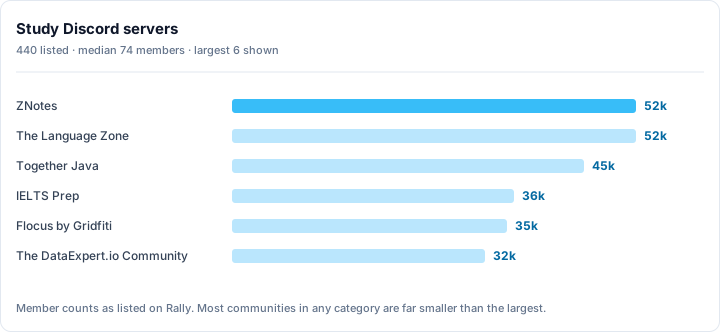
What Rally's Data Shows
The activity patterns in study communities follow rhythms you would not see in almost any other category. Gaming servers peak in evenings and weekends, but study communities show a more distributed daily curve with significant morning activity, a midday plateau, and consistent evening sessions. On weekends, many study communities rival their weekday engagement rather than dropping off, which points to something important: these communities are serving learners who have made studying a consistent practice, not just something they do when class demands it. Exam season creates pronounced spikes in communities organized around standardized testing - professional certifications, university entrance exams, bar and board exams - showing dramatic activity surges in the months before major testing windows. Retention in well-run study servers is remarkably high compared to most community types. Members who integrate a study server into their regular workflow tend to stay because the server becomes part of their routine. Servers with daily accountability systems, such as streak tracking, show measurably stronger retention.
Exam season creates pronounced spikes. Communities organized around standardized testing - professional certifications, university entrance exams, bar and board exams - show dramatic activity surges in the months before major testing windows. These are not passive communities that happen to exist during exam season. They activate.
Retention in well-run study servers is remarkably high compared to most community types. Members who integrate a study server into their regular workflow tend to stay because the server becomes part of their routine, not just a resource they consult occasionally. Servers with daily accountability systems, such as streak tracking, show measurably stronger retention.
Consistency Over Size
Study communities with structured accountability systems - daily check-ins, focus rooms, and goal tracking - consistently outperform larger but less structured servers on the single metric that matters most: whether members actually return the next day.
The Ecosystem: Sub-Types of Study Communities
Understanding the different shapes these communities take helps you find the right fit faster.
Focus Room Communities
Built around the co-studying experience rather than content. The primary value is the ambient presence of other people working. Focus rooms are voice channels where members work in silence or with lo-fi music, often using structured techniques like Pomodoro. The community glue here is not shared subject matter - it is shared discipline. These communities attract a broad mix of learners from completely different academic backgrounds because the subject does not matter. What matters is showing up.
Subject-Specific Academic Communities
Organized around a field of study - mathematics, biology, computer science, philosophy, literature, languages. These communities run deeper on content. You will find subject-specific help channels, curated resource libraries, peer tutoring systems, and study guides built collaboratively over time. The best subject-specific communities develop a kind of institutional knowledge that makes them genuinely useful references, not just chat rooms.
Exam Prep Communities
Built around a specific high-stakes test - the LSAT, MCAT, GRE, IELTS, USMLE, AWS certifications, the CPA exam. These communities have a defined purpose and often a defined endpoint, which creates unusual intensity and focus. Members share practice materials, timed test schedules, score comparisons, and post-exam debriefs. Because everyone has the same immediate goal, cohesion forms quickly. Some of these servers run for years, cycling through cohorts of candidates who eventually pass and then return to help the next wave.
International Student Communities
Where academic life intersects with the experience of studying in a different country or language. These communities provide academic support alongside practical guidance - navigating visa requirements, understanding grading systems, finding housing, managing culture shock. They often have a multilingual character and serve as a lifeline for students who arrived somewhere new without an established support network.
Self-Learning and Skill Development
Not formal students but serious learners. These communities form around skill-building goals - learning to code, mastering a language, developing design skills, understanding finance. The academic structure is self-imposed, which means accountability systems become even more important. The best self-learning communities have clear goal-setting frameworks and celebrate milestones in ways that keep momentum going.
What the Best Study Communities Do Differently
The difference between a study community that genuinely helps people learn and one that is a well-intentioned ghost town comes down to a few specific practices.
They design for return visits. The best study servers give you a reason to come back tomorrow, not just today. Daily check-in channels, streak systems, and weekly reflection threads create the habit loop that transforms a one-time join into a regular practice. If a server has no mechanism for bringing you back, it is relying entirely on your own motivation - which is exactly the resource that studying most depletes.
They take moderation seriously. Study communities need a specific kind of moderation that is different from gaming or social servers. Off-topic noise in the wrong place is genuinely disruptive to people who came to focus. The best servers enforce channel discipline firmly but without hostility - keeping study channels productive while providing designated spaces for socializing. This balance is harder to maintain than it sounds, and servers that get it right earn exceptional loyalty from their members.
They manage the help-channel dynamic well. Subject-specific help channels can either be community assets or sources of frustration, depending entirely on how the server handles them. Communities that establish norms around question quality, response culture, and intellectual respect develop into genuine peer learning environments. Communities that let help channels become dumping grounds for homework questions get overrun and stop serving anyone well.
They create a sense of shared progress. The most motivating study communities find ways to make individual progress feel collective. Shared exam countdowns, community goal boards, milestone announcements, monthly reflection threads - mechanisms that transform a collection of isolated learners into people who feel like they are moving toward something together.
Voice Channel Visibility
Before joining any study server, check whether its focus room voice channels are actually populated during your typical study hours. A server with five empty focus rooms tells you more about community health than any description ever could.
How to Find the Right Study Community
The right study community for you depends on what kind of structure you need and what you are working on.
If you need ambient accountability above all else, look for servers centered on focus rooms and co-working. The subject mix of other members does not matter - you just want people to study alongside.
If you need subject-specific help, find communities organized around your field. Look at how active their help channels are and what the quality of discussion looks like. A channel full of substantive questions and detailed answers is a good sign. A channel with questions that go unanswered for days is not.
If you are preparing for a specific exam, seek out communities built explicitly around that test. The shared goal creates a level of cohesion and resource quality you will not find in a general study server.
Browse active study communities to see which ones have genuine ongoing engagement. Activity metrics matter here as much as anywhere - a study server with no one in it at 9pm on a weekday is not actually helping anyone study.
For Study Server Builders
If you are building or running a study community, the most important investment you can make is in your accountability infrastructure. Daily check-in channels, focus room culture, and visible progress tracking are not nice-to-haves - they are the core product. The community that helps people actually do the work will retain members. The community that just talks about studying will not.
Moderation is your second most critical investment. Study communities need moderators who understand the specific culture - people who enforce channel discipline gently but consistently, who understand the difference between a student who is struggling and one who is off-topic, and who model the kind of intellectual engagement the community is trying to cultivate.
Consider structuring your onboarding around goals rather than rules. When a new member joins and is immediately asked what they are working on and invited to check in tomorrow, you have created the beginning of a habit. When a new member reads a list of rules and then lands in a general chat with no clear next step, you have not.
Finally, think carefully about your channel architecture before you launch and before you expand. The study servers that maintain quality as they grow are ones with a clear organizational logic - subject areas do not bleed into each other, focus rooms have norms, and every channel has a specific purpose. Chaotic channel structures kill study communities quietly, one frustrated member at a time.
The learners building communities on Discord have figured out something that took formal education decades to articulate: accountability is infrastructure. When you build that infrastructure thoughtfully, you build something genuinely useful - and people come back because it works.
Browse study and education communities on Rally, or add your server if you are running something worth discovering.