Programming is fundamentally a social discipline disguised as a solitary one. The image of the lone developer - headphones on, code scrolling at midnight, solving problems through sheer individual concentration - is real in its details but misleading in its framing. The best programmers are embedded in learning networks: communities of people who read each other's code, ask better questions than they could have formulated alone, and accumulate institutional knowledge that no single person could hold.
Discord has become the dominant platform for those networks. What was once distributed across IRC channels, Stack Overflow comment threads, mailing lists, and occasional meetups has largely consolidated here - in language-specific servers, framework communities, and general development hubs that range from small and specialized to some of the largest communities on the platform.
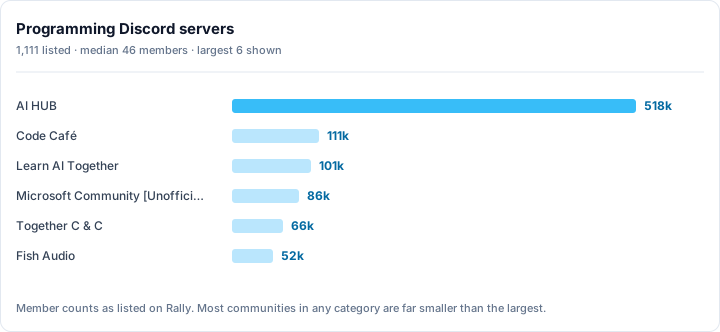
What Rally's Data Shows
Programming communities show engagement patterns that are distinctly different from entertainment or social categories. Activity is distributed more evenly across days of the week - developers have questions on Mondays as often as on Fridays, and help-seeking behavior follows work and learning schedules rather than leisure time. The weekend drop-off that is pronounced in gaming and entertainment communities is much shallower in technical communities. This pattern reflects how programming is fundamentally a social discipline embedded in learning networks, where developers rely on communities to read each other's code, ask better questions, and accumulate institutional knowledge. Help channel activity serves as the most reliable indicator of community health in programming servers. A help channel that gets substantive questions and detailed, accurate responses within reasonable timeframes is evidence of a functioning knowledge-sharing ecosystem. Retention here follows a different pattern to most categories: members who find genuine value stay and contribute back, turning from question-askers into answer-providers as they gain experience.
Help channel activity is the most reliable indicator of community health in programming servers. A help channel that gets substantive questions and detailed, accurate responses within reasonable timeframes is evidence of a functioning knowledge-sharing ecosystem. A help channel where questions go unanswered for hours, or where responses are curt and unhelpful, indicates that the community either lacks experienced members or has a culture that does not incentivize contribution.
Retention in programming communities follows a different pattern than most other categories. Members who find genuine value - who have a question answered, whose code review was substantive, who learned something specific - tend to stay and contribute back. The knowledge gradient is the retention mechanism: as members become more experienced, they transition from question-askers to answer-providers, which creates a durable role within the community that keeps them engaged long after their initial question was resolved.
The Ecosystem: Types of Programming Communities
Language-Specific Communities
Organized around a single programming language - Python, JavaScript, TypeScript, Rust, Go, Java, C++, Ruby. These servers go broad rather than deep on any specific use case, which makes them valuable precisely because the discussion covers the language across its full range of applications. A Python community might have active discussion of web development, data science, automation, game development, and systems programming all in parallel.
Language communities tend to have the most comprehensive beginner infrastructure because the new-learner pipeline is a constant presence. Resources for absolute beginners, self-learning roadmaps, and mentor programs are more common in language servers than in more specialized communities.
Framework and Library Communities
Narrower and more advanced. React, Vue, Django, FastAPI, Rails, Spring, PyTorch - these servers attract members who are already working within a specific ecosystem and need deeper knowledge. Discussion assumes shared baseline knowledge and moves quickly into nuanced territory: performance optimization, architectural patterns, edge cases, and integration challenges.
The best framework communities have a direct relationship with maintainers or are maintained by the core team, which means questions sometimes get answered by the people who actually built the thing. This is a qualitatively different experience than community-only support.
General Software Development Hubs
Cross-language spaces for programmers who work across multiple technologies or who want broader community than a single language provides. The best general development servers have strong channel organization - language-specific zones within the server, career channels, architecture discussions, tooling channels - so that breadth does not collapse into chaos.
These servers tend to attract more career-oriented discussion: job searches, salary questions, interview preparation, the dynamics of engineering culture. For developers navigating the professional landscape alongside the technical one, general development communities often provide context that specialized language servers do not.
Open Source Communities
Organized around a specific open source project or around the practice of open source contribution more broadly. Project-specific open source communities are functional communities for contributors - bug triage, feature discussion, pull request coordination, and documentation work all happen here. Broader open source communities serve developers who want to participate in open source but need guidance on finding projects, understanding contribution norms, and building the skills to contribute effectively.
Career and Job Hunting Communities
A category that has grown substantially. These communities provide job board channels, interview preparation resources, resume review, salary negotiation guidance, and referral networks. The best career communities have strong industry connectivity - employers who post openings directly, senior developers who have done actual hiring and can contextualize what employers are looking for, and a culture that is honest about the realities of the job market rather than purely motivational.
Specialty Technical Communities
Game development, security research, embedded systems, blockchain development, data science, machine learning, DevOps - technical specialties with their own tooling, culture, and career paths. These communities are smaller than general programming spaces but more focused, with a higher average experience level and more specialized knowledge available.
What Makes the Best Programming Communities Stand Out
Help channel culture is the defining characteristic. The difference between a programming community that accelerates member learning and one that is frustrating to participate in comes down almost entirely to how help channels work. Specifically:
Servers that require minimal reproducible examples - actual code that demonstrates the problem, not descriptions of code - get significantly better answers because answerers have something concrete to work with. Servers that use threads for help discussions keep context contained and make it easier to follow up without flooding the main channel. Servers where senior members actively monitor help channels and respond promptly create positive feedback loops where the culture of helping reinforces itself.
The opposite failure mode is equally instructive: servers where experienced members respond to beginner questions with condescension, where RTFM-style responses are normalized, and where asking a "dumb question" is a social risk create communities that are effectively inaccessible to anyone still learning. This is a cultural failure with practical consequences - it means the community only serves people who are already past the point of needing help.
Code review culture distinguishes good communities from excellent ones. The best programming communities go beyond answering questions to actually engaging with members' code at a higher level - not just "this will work" but "here is why this pattern is preferable, here is what you would want to consider at scale, here is the idiomatic approach in this language." This kind of engagement accelerates learning far faster than Q&A alone.
Resource curation is a community investment that compounds. A programming community that has carefully curated learning resources - organized by topic and experience level, regularly updated, built on community consensus about what actually works - has created a durable asset. New members benefit from it immediately, and the act of building and maintaining it creates ongoing community engagement around questions of pedagogy and quality.
The Help Channel Test
Before joining a programming community, browse its help channel and look at recent questions. How quickly are they answered? How detailed are the responses? Are follow-up questions handled patiently? This single channel reveals more about community health than any description.
How to Find the Right Programming Community
Match the community type to your current learning goal. If you are learning a language from scratch, find a language-specific server with robust beginner infrastructure. If you are working professionally with a specific framework and hitting advanced problems, a framework-specific community will serve you better. If you are navigating the career landscape, a general development hub with strong career discussion channels is worth finding.
Look at help channel activity and response quality before committing. A community that answers questions well is a community that will accelerate your learning. One that does not cannot provide the core value that makes programming communities worthwhile.
Check whether the community has a culture around code review and constructive feedback. Servers where members share projects and get genuine engagement - not just emoji reactions but actual technical discussion - are communities where you will grow faster than in spaces where sharing is met with silence or surface-level responses.
Browse active programming communities ranked by genuine engagement - the communities where developers are actually present and participating are the ones worth joining.
For Programming Community Builders
Help channel design is your most important architectural decision. Thread-based help channels with explicit formatting requirements dramatically improve the quality of exchanges compared to flat channels with no structure. Define your norms explicitly - what a good question looks like, how to share code (code blocks, not screenshots), what context to include - and enforce them gently but consistently.
Invest in your senior member community. The developers who answer questions are your community's most valuable resource. Recognize their contributions, give them appropriate roles, and make sure they feel respected. A community that loses its senior contributors loses the mechanism that makes it useful to everyone else.
Resource curation should be a community project, not an admin task. Creating structured opportunities for experienced members to contribute to resource libraries, nominate learning materials, and review existing content creates engagement while building the asset. The best programming communities have resource channels that are clearly the product of many hands.
Career infrastructure matters more than most programming community builders realize. Job boards, portfolio channels, resume review threads, and salary transparency discussions attract and retain members at critical career moments - when they are actively searching for work, when they are evaluating offers, when they are deciding whether to go freelance. These are high-stakes decisions where community support has real value.
The programming communities that endure are the ones that have actually helped their members become better developers. That is a high standard, but it is the right one to build toward.
Browse developer and programming communities on Rally, or add your server if you are building a technical community worth discovering.