Music communities on Discord have solved a problem that streaming platforms never could: the conversation around music. Spotify tells you what your friends listened to; a great music Discord tells you what they thought, why the bridge hits differently in the context of the album, which producer snuck a sample from 1973 into the second verse, and when the next listening party is scheduled. That gap between consumption and conversation is exactly where Discord music communities live.
With over 600 million registered users across 19 million servers, Discord hosts music communities at a scale and depth no other platform matches. The question is not whether these communities exist - it is what separates the ones generating daily conversation from the ones that post release announcements into silence.
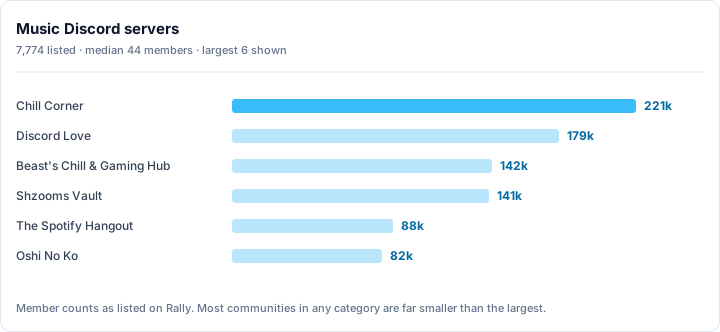
What Rally's Data Shows
Music communities on Discord display activity patterns distinctly different from other server categories. Unlike gaming servers, where voice channel presence serves as the primary health indicator, music servers engage members through multiple channels simultaneously: robust text discussions that sustain ongoing conversation, predictable activity surges tied to new releases and scheduled events, and a consistent baseline of engagement between those peaks in the strongest communities. The healthiest music servers maintain this distributed engagement model year-round, rather than depending entirely on external content calendars. Communities organized around internal culture - recurring events, conversation threads, and member-driven projects - generate momentum independent of label release schedules. Fan communities built around single artists show particularly strong retention when structured around participation-based activities like cover challenges, community playlists, and listening parties rather than announcement-only formats. This pattern reveals that sustained music community health depends less on what external creators release and more on what members create together.
The servers that rank highest for sustained activity share a common trait - they are not organized around a single artist's release schedule. Communities that depend on an external content calendar for their energy are vulnerable to long silences. The music Discord communities that thrive year-round have developed internal culture, recurring events, and conversation threads that generate their own momentum independent of what any label releases this Friday.
Fan communities built around a single active artist also show something interesting: the ones with the strongest activity tend to be organized around community projects rather than passive fandom. Cover challenges, community playlists, listening parties, fan theory threads. Participation drives retention in ways that announcement-only servers simply cannot replicate.
The Ecosystem: Types of Music Communities
Genre and Artist Fan Servers
The most common type and the widest in range. A well-run artist fan server is a remarkable thing - it functions simultaneously as a news aggregator, a discussion forum, an archival project, and a social group. The best ones have built genuine relationships between members that persist even when the artist goes quiet, because the people in the server are worth spending time with independent of the content that brought them there originally.
Genre servers operate at a different scale. A jazz Discord or a hyperpop server is not built around waiting for a specific person to release something - it is built around a shared aesthetic vocabulary that keeps generating conversation. Members bring new finds, debate canonical records, argue about sub-genre taxonomy with the intensity usually reserved for territorial disputes. The community is the content.
Music Production and Creator Servers
A completely different category with a completely different culture. Production servers attract beatmakers, mixing engineers, songwriters, vocalists, and instrumentalists who want to work rather than just listen. The activity is not discussion - it is output.
The quality floor matters enormously here. The best production servers have established hierarchies of trust: veteran producers whose feedback carries weight, established norms around how critique is delivered, and channel structures that separate finished showcases from works in progress seeking active notes. Beat marketplaces within production servers - channels where producers share work for licensing or collaboration - represent some of the more economically functional micro-communities Discord has produced.
What distinguishes a useful production server from an empty hype machine is the feedback culture. If the dominant mode of response to shared work is "fire" and nothing else, the server has no real value for anyone trying to improve. The servers worth joining are the ones where a detailed critique of your arrangement choices is a compliment, not an attack.
Music Theory Communities
Smaller and more specialized than fan or production servers, but with some of the most engaged members on the platform. Theory communities attract people who want to understand what they are hearing - why a chord substitution works, how rhythm functions differently across traditions, what the relationship is between a melody and its harmonic context.
The best theory servers anchor their community in practical application. Pure abstraction loses people quickly; connecting theory to tracks members actually love creates the hook that keeps discussions going. A thread analyzing the chord changes in a beloved song lands differently than the same theory discussed in the abstract.
Theory channels within larger music servers function as community anchors. They provide content that does not depend on new releases, they reward deep engagement over casual scrolling, and they consistently draw out the members with the most to say - which elevates the general quality of conversation across the whole server.
General Music Discovery Hubs
The broadest type and often the hardest to execute well. A discovery hub works when the curation is genuinely interesting - when members are bringing finds that other members would not have encountered on their own, rather than posting whatever is already at the top of the charts.
Successful discovery servers solve the curation problem through channel structure: genre-separated share channels so members can filter for what they are looking for, new-to-me reaction culture that rewards genuinely unfamiliar recommendations, and enough active membership that the stream of shares stays interesting without becoming overwhelming.
What Makes the Best Music Communities Stand Out
Listening party culture done right. A scheduled listening party - where members start an album simultaneously and react in real time in voice and text - is one of the highest-value experiences a music Discord can offer. The servers that have built this into recurring ritual rather than occasional event have cracked something important: a reason to show up at a specific time that does not depend on a new release.
Feedback culture, not hype culture. In production and creator spaces especially, the willingness to give honest, substantive feedback is the differentiator between servers that help people grow and servers that provide empty validation. Look for servers where the rules explicitly address feedback norms - this signals intentional culture-building, not accidental development.
Music theory channels as anchors. Even in fan and discovery servers, a dedicated theory or analysis channel provides durable content that keeps generating conversation. Albums get unpacked, production choices get analyzed, influences get traced. This content does not expire.
Event infrastructure that actually runs. Beat battles with judges and prizes, cover challenges with community voting, producer showcases with feedback sessions - servers that build event infrastructure and run it consistently on schedule retain members because those events are worth putting on a calendar.
Check the Listening Party History
Before committing to a music server, look at whether their scheduled events actually happened as announced. A server that creates events and then goes quiet is showing you something important about its reliability and community health.
How to Find the Right Music Community
Match the server type to what you actually want from it. If you want to improve your production, a fan server for your favorite artist will not help you - find a production-focused community where critique is part of the culture. If you want to discuss music deeply with people who care about the same sounds you do, a genre-specific discovery server will deliver more than a general hub.
For fan communities, look for evidence of life between releases. Scroll back through chat history during a period when the artist was not actively releasing. If conversation sustained itself, the community has built something independent of the content calendar. If the channels went silent, you are looking at a notification subscriber list with a server skin.
For production servers, observe the feedback channel before investing deeply. The quality and specificity of responses to shared work tells you everything about whether the server can actually help you grow.
Browse music communities on Rally to see which ones are genuinely active. Activity rankings show concurrent presence - the servers full of real people engaged right now, not the ones that most recently posted a bump.
Activity Over Aesthetics
The most common failure mode in music Discord servers is optimizing for looking official rather than being active. A polished server with twelve categorized channels and a custom emoji set but no ongoing conversation is less valuable than a scrappy server where the same twenty people show up every day and actually talk.
For Music Server Builders
The single most important structural decision is whether your server's activity depends on external events or generates its own. If you are building around an artist or a release calendar, invest in events that create community activity between those external moments - listening parties for catalog records, member-curated theme months, production challenges that have nothing to do with what any label is doing this week.
Invest in your feedback culture before you invest in your channel structure. The norms you establish early in a production or creator server persist longer than any channel architecture. If the first wave of feedback is vague and complimentary, you have built a culture of empty hype that is very difficult to reverse later. Establish the expectation of substantive critique from the beginning.
Music theory channels are underutilized in fan servers. Adding a dedicated analysis channel - with a culture of genuine member-generated discussion, not just shared links - consistently elevates the quality of conversation across the entire server.
If you are running a music community with real consistent activity, list your server on Rally to reach the listeners, producers, and theorists who are actively searching for what you have built.
The music servers that stand the test of time are not the ones built around waiting for the next release. They are the ones where the community itself has become the point. Build the events, establish the culture, make critique welcome - and the membership that matters will find its way in.
Explore music communities on Rally and find your people.