


Philosophy has always been a fundamentally conversational discipline. Socrates did not write books - he walked through Athens asking questions. The dialogues of Plato are arguments between people, not lectures from a single authoritative voice. Philosophy at its best is a collaborative search for truth through rigorous questioning, and Discord has created the infrastructure for that to happen at unprecedented scale.
With 19 million active servers on the platform, philosophy communities represent some of the most intellectually serious spaces on Discord. The best ones are genuine communities of inquiry - people from radically different backgrounds, educations, and life experiences engaging seriously with questions that have resisted easy answers for thousands of years.
Why Philosophy Thrives on Discord
Discord's text-based architecture supports the kind of careful, slow-moving argumentation that philosophy requires because philosophy has always been fundamentally conversational - Socrates walked through Athens asking questions rather than writing books, and Plato's dialogues are arguments between people, not lectures from authority. A good philosophical exchange cannot be rushed: premises need stating, definitions need clarifying, implications need tracing. Discord's persistent channels, thread support, and asynchronous engagement create exactly the right conditions for this dialogue. Unlike platforms where arguments compress into assertions or confident consensus, Discord philosophy communities can sustain genuine uncertainty, allowing members to change their minds mid-conversation and return days later with new considerations. This infrastructure enables the collaborative search for truth through rigorous questioning that philosophy at its best demands, bringing together people from radically different backgrounds and life experiences to engage seriously with questions that have resisted easy answers for thousands of years.
Unlike Twitter, where philosophical arguments get compressed into assertions with no room for nuance, or Reddit, where top-voted comments tend toward confident consensus rather than productive doubt, Discord philosophy communities can sustain genuine uncertainty. Members can change their minds mid-conversation, acknowledge when an argument defeats them, and return to a thread days later to add a consideration they missed.
The voice channel capability adds another dimension. Live philosophical dialogue - Socratic questioning in real time - happens in well-organized philosophy servers regularly, and the experience is qualitatively different from text-only engagement.
Categories of Philosophy Discord Servers
General Philosophy Communities
The broadest type - these servers welcome discussion across all philosophical traditions and domains. The best ones organize channels by philosophical discipline (ethics, metaphysics, epistemology, political philosophy, aesthetics, logic) and by tradition (analytic, continental, Eastern, feminist, pragmatist), so members can find the conversations that match their interests.
General philosophy servers attract enormous diversity: undergraduates working through introductory courses, autodidacts who discovered philosophy through a book or podcast, graduate students and academics participating as enthusiasts, and people with no formal philosophy background who simply find the questions compelling. This diversity is a feature, not a bug - good philosophy benefits from fresh perspectives as much as from expertise.
The best general servers also host reading groups with scheduled discussions of specific texts, which creates structured engagement beyond open-ended conversation.
Ethics and Applied Ethics Communities
Among the most practically relevant philosophy communities. Ethics servers engage with questions about how to live, what we owe to others, what makes actions right or wrong, and how abstract moral principles apply to concrete situations.
Applied ethics communities extend this to specific domains: AI ethics (how should we govern artificial intelligence? what moral status might future AI systems have?), bioethics (informed consent, end-of-life decisions, genetic engineering), environmental ethics (what moral obligations do we have to non-human animals, ecosystems, and future generations?), and political ethics (questions of justice, rights, and institutional design).
These communities attract people who want to think rigorously about questions that genuinely matter. The discussions often connect to contemporary policy debates, but the best ethics servers maintain focus on the philosophical questions rather than becoming political discussion spaces.
Epistemology and Philosophy of Mind
Epistemology - the study of how we know what we know - and philosophy of mind - questions about consciousness, perception, and the nature of mental states - are two of the most vigorously active areas in contemporary philosophy, and their Discord communities reflect this.
These servers engage with questions like: What is the relationship between mind and brain? Can we trust our perceptions of external reality? What is the hard problem of consciousness and why has it resisted solution? Do we have free will? What is personal identity over time?
Philosophy of mind communities increasingly overlap with communities interested in AI and cognitive science, creating rich interdisciplinary conversations. The hard problem of consciousness - why there is subjective experience at all, not just information processing - is one of the most contentious and fascinating open questions in all of philosophy, and Discord communities discussing it are often among the most intellectually energetic.
Existentialism and Continental Philosophy
Existentialism, phenomenology, post-structuralism, critical theory, and related traditions represent a significant strand of philosophy Discord. These communities engage with thinkers like Sartre, Heidegger, Camus, Nietzsche, Foucault, and Derrida - and with the fundamental questions of meaning, authenticity, freedom, and the structures of human experience.
Continental philosophy Discord tends to attract people grappling with questions that feel personally urgent: What does it mean to live authentically? How do structures of power shape what we can think and say? Is meaning created or discovered? What does it mean to confront mortality?
These communities vary enormously in rigor. The best combine genuine engagement with the primary texts (reading Heidegger or Sartre directly rather than summaries) with openness to the existential weight of the questions. The worst use continental philosophy jargon as performance rather than tool for thought.
Stoicism and Practical Philosophy
A distinct and rapidly growing category. Stoicism - the ancient Greek and Roman philosophy of focusing on what you control, developing virtue as the highest good, and maintaining equanimity in the face of external fortune - has experienced a major revival in the 2020s.
These communities are more practically oriented than academic philosophy servers. Members discuss how Stoic principles (from Marcus Aurelius, Epictetus, Seneca) apply to daily life, how to build psychological resilience, and what a life oriented around virtue rather than comfort looks like in practice.
Stoicism Discord overlaps with self-improvement communities in some ways, but the best Stoic communities maintain philosophical seriousness - they engage with the texts, debate interpretations, and apply Stoic principles critically rather than treating them as productivity hacks.
What Separates Good Philosophy Communities From Bad Ones
Intellectual humility. Philosophy has been wrestling with many of its central questions for thousands of years without resolution. A community that treats these questions as having obvious correct answers has confused confidence for understanding. The best philosophy communities model genuine uncertainty and reward members for changing their minds when presented with good arguments.
Argument standards. Philosophy requires a minimum level of logical rigor. Claims need to be stated as claims, not assertions. Premises need to be made explicit. Implications need to be traced. The best communities enforce argument quality norms - not necessarily formally, but culturally.
Engagement with actual texts. Philosophy divorced from the philosophical tradition is often reinventing wheels poorly. Communities that engage with actual philosophical texts - even introductory summaries - have a richer shared vocabulary and can avoid the mistake of confidently rediscovering positions that were refuted centuries ago.
Welcoming genuine questions. The fastest way to kill a philosophy community is to make people afraid to ask beginner questions. Philosophy starts with "I don't know, and I want to understand." Communities that shame that starting point will remain small and insular.
Distinguishing philosophy from debate-winning. Some philosophy-adjacent spaces become about winning arguments rather than seeking truth. This corrupts the enterprise entirely. Philosophy is adversarial in the sense that arguments should be challenged vigorously - but the goal is truth, not victory.
Red Flags in Philosophy Discord Servers
Pop philosophy as a substitute for rigor. Motivational quotes attributed to Nietzsche or Seneca out of context, philosophy reduced to aphorisms, or serious questions answered with "well, it depends on your perspective" as if relativism ends rather than begins discussion - these indicate a community that has the aesthetic of philosophy without the substance.
Ideological alignment disguised as philosophy. Philosophy communities sometimes attract people who want to use philosophical vocabulary to advance predetermined political positions. The tell is that arguments lead to a predictable ideological destination regardless of the philosophical starting point. Real philosophy follows the argument wherever it leads.
No challenge to confident claims. A healthy philosophy community will push back on confident assertions regardless of ideological content. If you can post "consciousness is obviously just computation" or "morality is objectively real" and receive only agreement, the community is not doing philosophy.
Technical jargon as gatekeeping. Philosophical terminology serves a function - precision that ordinary language lacks. But when jargon is used to exclude rather than clarify, it signals that the community values in-group signaling over intellectual inquiry.
Toxic debate culture. Some philosophy communities mistake aggression for rigor. Attacking people rather than their arguments, showing contempt for those who disagree, or treating philosophical "wins" as personal dominance are all signs of a community that has confused philosophy with combat.
A Good Starting Point
If you are new to philosophy Discord, start by reading a few recent threads before posting. Get a sense of the community's norms, the level of rigor expected, and the common reference points. Then start with a genuine question - even a simple one. Good philosophy communities welcome sincere inquiry at any level.
Find Philosophy Communities on Rally
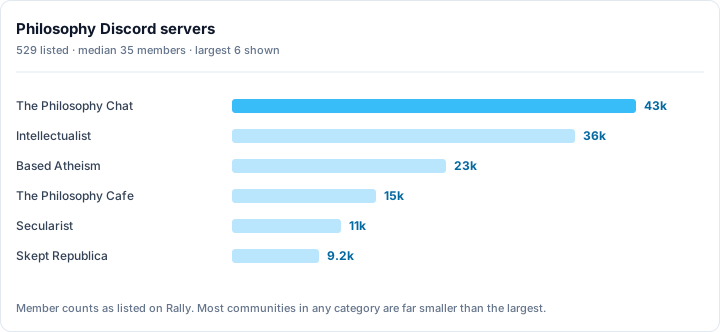
Rally tracks activity across thousands of Discord communities in real time. Browse philosophy servers to find communities ranked by genuine engagement - active discussion threads, regular reading groups, and members engaging seriously with philosophical questions. The activity rankings surface communities where real intellectual conversation is happening, not just servers that were once active before going dormant.
Whether your interest is ethics, metaphysics, existentialism, stoicism, or the full breadth of philosophical inquiry, there are Discord communities where your questions will be engaged seriously. The ones worth your time are the ones where the arguments go somewhere - where you leave a conversation thinking differently than when you arrived.